

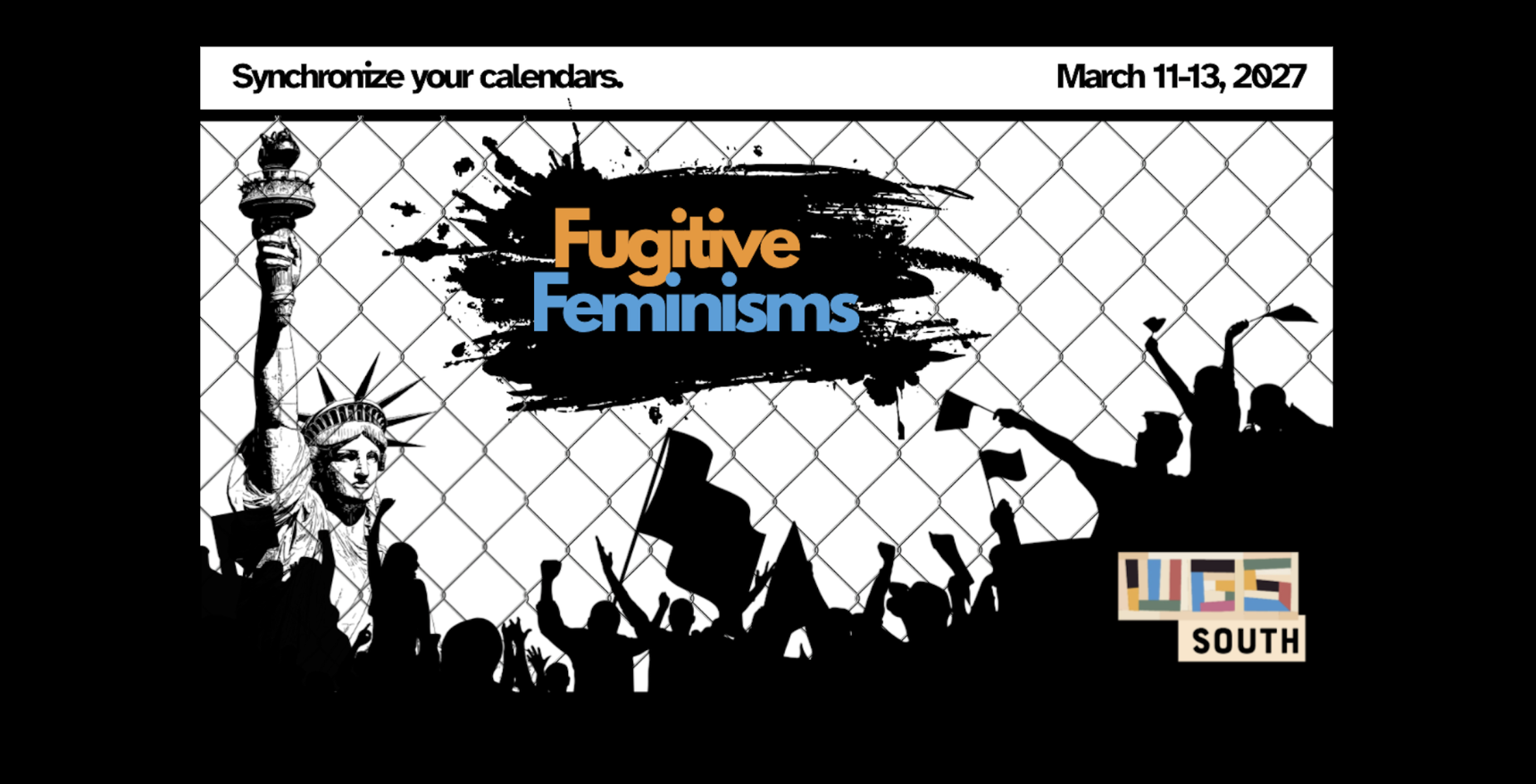
Fugitive Feminisms: Resistance in a New Age of American Fascism
In a political and cultural moment when feminisms are under attack, WGS South invites our community to engage with the generative nature of fugitivity.
Fugitivity has long been part of the traditions of Black, Indigenous, and queer-feminist study and practice. Whether in the writings of Harriet Jacobs documenting her view of the world from the garret where she spent seven watchful years before gaining her freedom from enslavement, in Indigenous practices of refusal of colonial demands, or early feminists’ gatherings where they unearthed the functions of patriarchy through consciousness-raising, feminisms have long found nutrients in the underground. Amidst budget slashing and program closures, we choose to respond to threats to our discipline’s future by insisting on the importance of continuing on alongside one another, shifting our structure to meet our community where they are.
Our 2026 Conference theme, “Feminist Futurities: 50 More Years of Feminist Scholarship and Activism in the South,” asked participants to “draw on the reserves of feminist pasts to think through and plot the next 50 years, recognizing the necessity of playing the long game, through setbacks and backlash and all manner of detours and obstacles.” This year, we aim to take this work a step further via an immersive virtual “unconference,” in which we are asking participant institutions and members around the South to create, gather, and share white papers and usable/customizable deliverables that students, academics, organizers, and activists can use to help them do the work of intersectional feminism even as it is under threat.
Rhetoric and Professional Communications scholars (Figueireido & Green) are already working to Humanize the Metaverse (forthcoming 2027), which is an excellent starting place for planning how the field of women, gender, and sexuality studies might Feminize the Metaverse and emerging digital environments. (Add scholars from other fields and their relevant work)
How do we enmesh the integration of intersectionality and gender equality into both existing and emerging technology sectors? What are the spaces (physical or virtual) that we personally inhabit? How can we encourage more equitable environments? How do we foster the desire for social justice and equity with others who aren’t already activists/advocates? In an age of human and civil rights offenses, how can the aggrieved take the offensive?
While we are still accepting and encouraging individual presentations, we are hoping to register “Hubs” around the south for scholars and community members to come together and work on real-word solutions for resistance in an age of American fascism.
Topics may include, but are not limited to:
- WGS in digital environments
- Engaging men & boys
- Creating roadmaps for intersectionality
- Intersectionality in mentoring and evaluation
- Long-term solution frameworks
- Engaging community organizers and institutions outside of the academy
- Gaming and online communities
- Accessibility for all
- Elevating marginalized voices
- Pay equity & transparency
- Countering Violence
- Care work amidst precarity
- Feminist responses to shifting legal status amongst immigrant communities
- The limits of feminist fugitivity - strategies for getting loud
- Incarceration & Human Rights Violations
We welcome individual paper proposals, panel proposals, workshops, performances, and other creative formats that engage with the conference theme. Submissions from scholars at all career stages, activists, community organizers, and artists are encouraged.
Please submit abstracts of no more than 300 words, along with a brief bio (100 words), through the conference submission link by November 15th, 2026. Panel proposals should include a 500-word abstract describing the panel's theme and objectives, as well as individual abstracts and bios for each panelist. The submissions portal will include the option to be considered for one of our Caucus-sponsored sessions. Caucus CFPs to be released October 15th, 2026.
-
TBA
WGS South 2027 BIPOC Caucus
Call for Papers
Deadline: November 15th, 2026In Freedom Dreams: The Black Radical Imagination, Robin D. G. Kelley asks what revolutionaries dream of. His inquiry extends beyond what sparks revolutions to the visions that sustain them—the imagined lives after struggle and the seeds that nurture revolutionary spirit.
For the 2026 WGS South Conference, the BIPOC Caucus invites submissions that explore vision, imagination, and futurity for BIPOC persons and communities. While previous calls have centered on how BIPOC communities draw from the past to shape the present, this year we turn toward the future—daring to imagine worlds where Southern BIPOC people not only survive, but thrive.
In an era when conversations about race, difference, and justice are increasingly constrained, the act of imagining itself becomes radical. With the stressors from the current political climate, BIPOC persons are more likely to engage in safety rather than dreaming. Too often, survival leaves little room for dreaming. This year’s BIPOC caucus seek to reclaim that space—to dream collectively, to vision boldly, and to articulate futures grounded in liberation, care, and possibility.
We invite scholars, artists, activists, and community members to consider:
What does the future look like for BIPOC communities in the South and beyond?
How can we create worlds where BIPOC people are treated as fully human?
What does it mean to move from resistance to creation, from critique to vision?
In response to Kelley’s enduring question—“We know what they are fighting against, but what are we fighting for?”—the BIPOC Caucus calls for works that do more than describe the problem. We seek contributions that imagine new futures, grounded in radical love, freedom, and collective transformation.
Topics may include, but not limited to:
Imagination as a political act for Southern BIPOC communities.
The role of dreaming, vision, and imagination in BIPOC liberation movements.
Southern futurisms and reimagining Southern geographies for BIPOC communities.
LGBTQIA+, Queer and trans futures in the Black and Brown South.
Climate justice, land, and sustainability for BIPOC futures.
Dreaming as care work and community building.
Pedagogies of imagination and critical hope.
Creating liberatory classrooms and campuses.
Artistic, digital, and community-based practices of imagining.
Decolonizing futurisms: imagining beyond empire and extraction.
Indigenous and Afro-Indigenous visions of the South.
Feminist, queer, and disability justice approaches to radical futures.
Dreaming policy: abolitionist, reproductive, and environmental justice futures.
The WGS South BIPOC Caucus invites papers that address these or other related questions. Please submit paper proposals using the button below.
Please submit any questions to WGS South BIPOC Caucus Chair Jayme Canty at jcanty@cau.edu
-
TBA
WGS South 2027 - Disability Caucus
Call for Proposals
Deadline: November 15th, 2026“The future is disabled,” poet and disability justice activist Leah Laksmi Piepzna-Samarasinha argues in their 2022 book, aptly named The Future is Disabled: Prophecies, Love Notes, and Mourning Songs. In the book they ponder what disability justice looks like “at the end of the world.” Since the publishing of Piepzna-Samarasinha’s book three years ago, apocalypse and collapse feel more real than ever here in the United States. Feelings of hopelessness and grief seem to have only gotten more intense amidst the daily barrage of attacks on disabled lives that we witness offline and online through our screens. But we still trudge on, collectively, dreaming and actively creating different futures for ourselves and for those we love (human and non-human alike). For the upcoming 2026 conference, we invite scholarship that engages with these bad feelings and that takes up Piepzna-Samarasinha’s proclamation, observation, and crip axiom, “the future is disabled.”
We also broadly invite scholarship on the following timely topics:
• Pasts, presents, and futures of disability justice in the South
• Disability, the internet, and economies of mis/disinformation
• Crip technoscience
• Debility
• Madness
• Care work and disability intimacies
• Disability and crip futurity
• Healthism and/or wellness culture
• Legacies of eugenics
• Disability maker cultures
•Disability and environmental/climate justice
Please submit any questions to Disability Caucus Chair, Anastasia Todd (anastasia.todd@uky.edu).
-
TBA
WGS South 2027 - Fat Caucus
Call for Papers
Deadline: November 15th, 2026Trans, intersex, and queer life is under attack by authoritarian and regressive forces in the United States and in many places around the globe, particularly in the Southern US and the global south. In this context, the imaginative work of what historian Robin D. G. Kelly calls “freedom dreaming” takes on a heightened urgency, especially for preserving trans, intersex, and queer arts of living and thriving. As the general WGS South 2026 CFP “Feminist Futurities: 50 More Years of Feminist Scholarship and Activism in the South” asks, How can we make each other’s lives more possible? In that spirit, what organizing strategies, political tactics, knowledges, ethical orientations, and affective infrastructures can help us to cultivate post-scarcity, anticaptivity, and antisubordination forms of trans, intersex, and queer subjectivity, sociality, and becoming? How can we creatively and critically imagine the next 50 years of trans, intersex, and queer scholarship and activism in the South? How can histories of trans, intersex, and queer resistance, solidarity, and social transformation inform possibilities for imagining and articulating trans, intersex, and queer freedom dreams and futurities?
This year’s LGBTQ Caucus welcomes creative and critical papers that provide new perspectives on trans, intersex, and queer freedom struggles, dreams, and futurities, as well as the varied social justice movements multiply marginalized communities are building to sustain them. What lessons do trans studies, intersex studies, and queer theory offer for reconceptualizing the political climate and political economy of LGBTIQ life under an increasingly authoritarian state? How are trans, intersex, and queer communities devising strategies for critically analyzing and intervening in racial capitalism, white nationalism, the unequal distribution of life chances and health outcomes under neoliberalism, environmental devastation, war, anti-immigrant fervor, and technologies of misinformation and disinformation? How can trans studies, intersex studies, and queer theory help us to craft: new models of care and communal resistance to curative, administrative, and other forms of violence; new strategies of organizing and opposition; new forms of solidarity, mutual aid, and coalition across our many differences; and new articulations of the knowledges, affects, ethics, and politics that might be generative for making trans, intersex, and queer lives more livable and pleasurable?
The WGS South LGBTQ Caucus invites papers that address these or related questions.
Please submit questions to WGS South LGBTQ Caucus Chair David A. Rubin at davidarubin@usf.edu.
-
TBA
WGS South 2027 - LGBTQ Caucus
Call for Papers
Deadline: November 15th, 2026Trans, intersex, and queer life is under attack by authoritarian and regressive forces in the United States and in many places around the globe, particularly in the Southern US and the global south. In this context, the imaginative work of what historian Robin D. G. Kelly calls “freedom dreaming” takes on a heightened urgency, especially for preserving trans, intersex, and queer arts of living and thriving. As the general WGS South 2026 CFP “Feminist Futurities: 50 More Years of Feminist Scholarship and Activism in the South” asks, How can we make each other’s lives more possible? In that spirit, what organizing strategies, political tactics, knowledges, ethical orientations, and affective infrastructures can help us to cultivate post-scarcity, anticaptivity, and antisubordination forms of trans, intersex, and queer subjectivity, sociality, and becoming? How can we creatively and critically imagine the next 50 years of trans, intersex, and queer scholarship and activism in the South? How can histories of trans, intersex, and queer resistance, solidarity, and social transformation inform possibilities for imagining and articulating trans, intersex, and queer freedom dreams and futurities?
This year’s LGBTQ Caucus welcomes creative and critical papers that provide new perspectives on trans, intersex, and queer freedom struggles, dreams, and futurities, as well as the varied social justice movements multiply marginalized communities are building to sustain them. What lessons do trans studies, intersex studies, and queer theory offer for reconceptualizing the political climate and political economy of LGBTIQ life under an increasingly authoritarian state? How are trans, intersex, and queer communities devising strategies for critically analyzing and intervening in racial capitalism, white nationalism, the unequal distribution of life chances and health outcomes under neoliberalism, environmental devastation, war, anti-immigrant fervor, and technologies of misinformation and disinformation? How can trans studies, intersex studies, and queer theory help us to craft: new models of care and communal resistance to curative, administrative, and other forms of violence; new strategies of organizing and opposition; new forms of solidarity, mutual aid, and coalition across our many differences; and new articulations of the knowledges, affects, ethics, and politics that might be generative for making trans, intersex, and queer lives more livable and pleasurable?
The WGS South LGBTQ Caucus invites papers that address these or related questions.
Please submit questions to WGS South LGBTQ Caucus Chair David A. Rubin at davidarubin@usf.edu.
-
TBA
WGS South 2027 Student Caucus
Call for Proposals
Deadline: November 15th, 2026The poet and civil rights activist Audre Lorde once said, "If you can't change reality, change your perceptions of it." In a society that constantly tries to control who we are and confine us, Lorde's words continue to resonate in our world today. The first step toward transformation is changing perceptions—drawing upon the knowledge from the books we read as young people, such as The Hunger Games, The Giver, and Fahrenheit 451, etc. These are the very books that are being banned and removed from shelves because of the warnings and truths they hold about the power structures that govern our lives.
As Lorde reminds us, "In a world of possibility for us all, our personal visions help lay the groundwork for political action." Even when our current reality makes change feel impossible, this is precisely when we must call upon student leaders, writers, and activists who want to create meaningful impact for the better—those who believe that power belongs to the people, that dreams should be accessible to all, and that the future belongs to all humankind, not just a privileged few.
This year, WGS South invites young leaders and activists to envision and articulate the future they want to inherit and shape. We seek proposals that demonstrate how different generational perspectives and visions can transform reality and catalyze political change for collective liberation and justice.
Topics of Interest (but are not limited to):
● Youth activism and social movements
● Intersectionality and coalition building across identities
● Literature and art as tools for resistance and reimagination
● Banned books, censorship, and intellectual freedom
● Intergenerational dialogue and knowledge transfer
● Community organizing and grassroots leadership
● Digital activism and social media as platforms for change
● Environmental justice and youth climate movements
● Reimagining education and pedagogies of liberation
If you would like your work and ideas to be featured at the WGS South 2026 Conference, please tag your proposal to be considered for a special Student Caucus Panel. We welcome individual papers, panel proposals, creative presentations, workshops, and multimedia projects.
For more details, submission guidelines, and additional resources, please visit: https://wgssouth.org/2026conference
Questions? Please contact the 2026 Student Caucus Chair, Mariam Shafik, at mshafik@students.kennesaw.edu