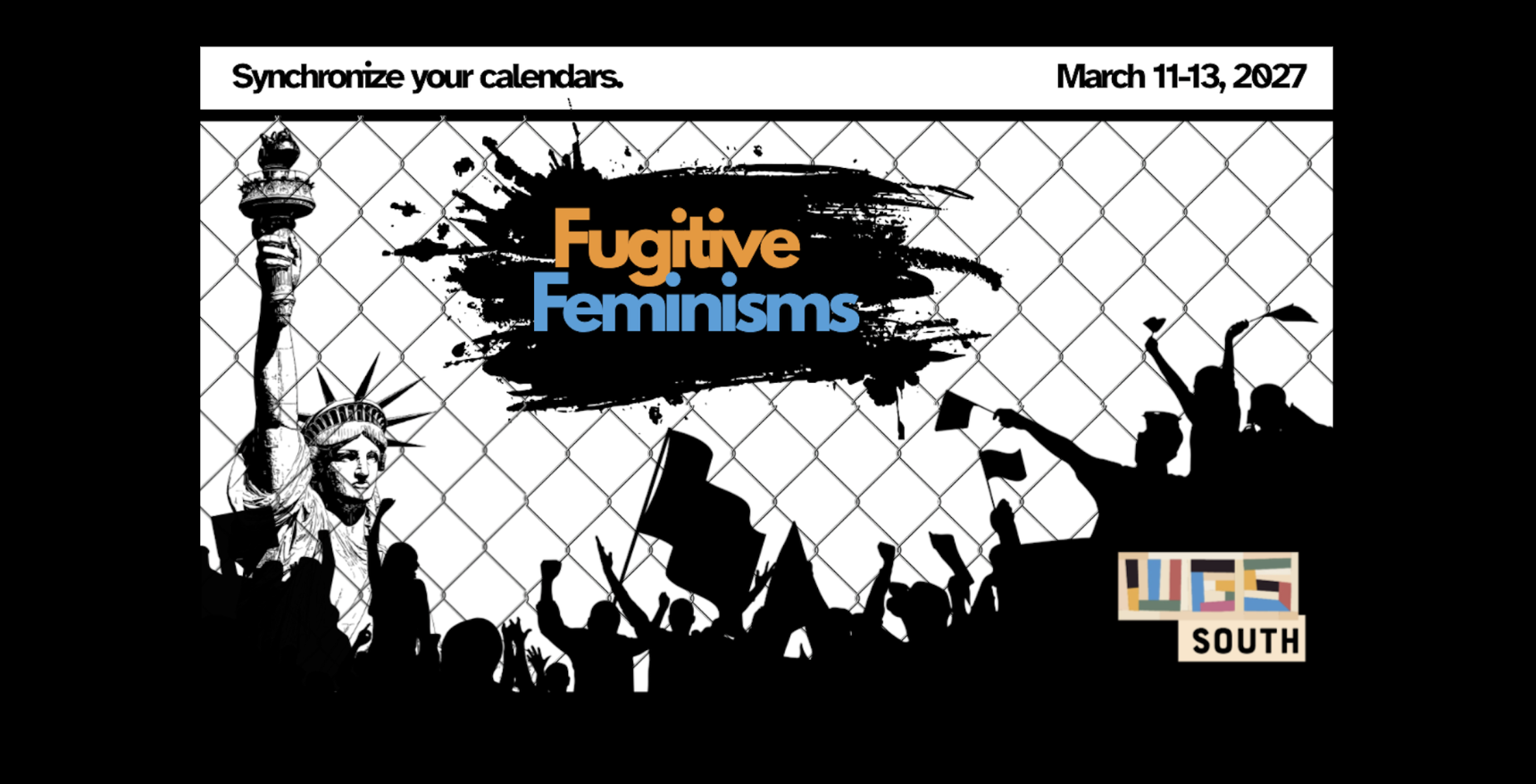
Fugitive Feminisms:
Resistance in a Renewed Age of Fascism
A Virtual Conference
In a political and cultural moment when feminisms are under attack, WGS South invites our community to engage with the generative nature of fugitivity.
Fugitivity has long been part of the traditions of Black, Indigenous, queer-feminist, and migrant and refugee study and practice. Whether in the writings of Harriet Jacobs documenting her view of the world from the garret where she spent seven watchful years before gaining her freedom from enslavement, in Indigenous practices of refusal of colonial demands, or early feminists’ gatherings where they unearthed the functions of patriarchy through consciousness-raising, feminisms have long found nutrients in the underground. Amidst budget slashing, program/department closures and faculty firings, we choose to respond to threats to our discipline’s future by insisting on the importance of continuing on alongside one another, shifting our structure to meet our community where they are in this season of challenge and change.
As WGS South enters our 51st year, we build on our 2026 conference theme of “Feminist Futurities” to ask what strategies from the past, present, and future can guide us through this transformative moment for our field. We invite participants to consider the ways fugitivity can serve as a generative force for building worlds otherwise, producing and living in joy while developing tactics of persistence, resilience, and liberation amidst attack. Particularly as WGS and allied disciplines in the US South and elsewhere are being forced underground, how can we find ways to move toward a more life-giving futurity as we embrace fugitivity in the now? On the other hand, what are the limits of fugitivity as a strategy within fascist regimes? Furthermore, given the virtual nature of this conference, we also invite feminist inquiry into and critique of the role of the digital in preserving (or preventing/disrupting) connection when austerity makes physical gatherings more challenging to facilitate.
We welcome individual paper proposals, panel proposals, workshops, author-meets-readers sessions, performances, and other creative formats that engage with the conference theme. Particularly for those working in visual formats, we are open to proposals for creative uses of our virtual space, including digital galleries or other modes of sharing audio or visual works. Submissions from scholars at all career stages, activists, community organizers, and artists are encouraged.
Topics may include, but are not limited to:
Theories and Practices of Coalition, Collaboration, and Accompliceship
Artistic or visual presentations of fugitivity and revolt
Strategies for Survival, including care work, spirituality, and mutual aid
Resistance Archives, Memory Studies, and other repositories of struggle
Stories from Campus - Departments and Programs navigating threats
Feminism beyond the Ivory Tower - engagements with community organizers and institutions outside of the academy
Feminist responses to the militarization of immigration enforcement
Survivance strategies for migrant and refugee communities in the US and Global South(s)
Abolitionist and anticolonial feminisms
Histories and presents of queer and trans survival under authoritarianism
Transnational approaches to feminist fugitivity
Queer and feminist approaches to climate crisis
Approaches to reproductive justice work after Dobbs
Feminist fugitivity and the internet
The limits of feminist fugitivity - strategies for getting loud
All submissions are due to the conference submission form by December 1, 2026. We are also offering a Priority Funding Deadline for participants who may require earlier notification of acceptance to apply for conference funds; those interested in this option should submit materials by November 15.
Please submit abstracts of no more than 300 words for individual papers, along with a brief bio (100 words). Panel proposals should include a 600-word abstract describing the panel's theme and objectives, as well as individual abstracts and bios for each panelist. The submissions form will include the option to be considered for one of our Caucus-sponsored sessions. Caucus CFPs to be released October 15th, 2026.
-
WGS South 2027 BIPOC Caucus
Call for Papers
Deadline: December 1st, 2026Acknowledging and Honoring Feminist Fugitivity for Future BIPOC Survivance, Thrivance, and Creative Feminist Leadership Under Fire
Futurity is not a luxury; it is a vital necessity of our existence. Future feminist visions are created, calibrated, and sustained by our labor, art, dreaming and spiritual activism. As we mark half a century of feminist scholarship and activism in the U.S. South, the Black, Indigenous, and People of Color (BIPOC) Caucus invites academic, creative, practices, models and rituals proposals that center the lived experiences, genealogies, resistance movements, liberation topologies of BIPOC communities across the region.
As we consider our position in history as the oldest women, gender, and sexuality studies association in the nation, how do we sustain, and increase the presence of BIPOC leaders in our organization, our communities and institutions? We contest and resist the fugitive state of our minds, bodies, communities, infrastructures that want to keep us captive and stifle our dreams for a different future.
Southern feminisms cannot exist without the labor, intellectual traditions, and grassroots organizing of Black, Indigenous, Latina, Asian, and global majority women, non-binary, and trans people. We invite scholars, activists, artists, community organizers, and elders to submit individual papers, organized panels, workshops, and creative performances that dream, interrogate, and enact the next 50 years of radical Southern feminist futures for BIPOC communities.
Please direct questions to wgssouthorg@gmail.com.
-
WGS South 2027 - Disability Caucus
Call for Proposals
Deadline: December 1st, 2026“Tinkering, Maintaining, Hacking: Disability Wisdom for a Renewed Age of Fascism”
What wisdom does the lived experience of disability, madness, and chronic illness offer in a renewed age of fascism? “Disabled people are experts and designers of everyday life,” posit crip STS scholars Hamraie and Fritsch (2019) in their “Crip Technoscience Manifesto.” From smashing curbs to hacking assistive technology, disabled people have long been tinkering, making, and building more accessible worlds. Perhaps less flashy, but necessary, is the slow, everyday work of maintenance and care. When all we have is each other, what does the mundane, slow work of maintenance and care look like? What does it offer us?
For the upcoming 2027 conference, the Disability Caucus invites scholars to submit papers, panels, and creative works that engage with this sub-theme of tinkering, maintaining, and hacking. We also broadly invite scholarship and creative works on the following related topics:
Histories of disability justice/activism under global fascism
Disability and the climate crisis
Feminist of color disability studies
Debility, immigration, and detention
Disability and the internet: AI slop, doomscrolling, and brain rot
Disability and higher ed
The intersection of trans studies and disability studies
Precarious labor, the gig economy, and disability
Surveillance and disability
MAHA, healthcare, and the ADA under Trump 2.0
Please submit any questions to Disability Caucus Chair, Anastasia Todd (anastasia.todd@uky.edu).
-
WGS South 2027 - Fat Caucus
Call for Proposals
Deadline: December 1st, 2026“Forming Fat Futures: Dignity in an Era of Resurgent Anti-Fatness”
In September 2025, Defense Secretary Pete Hegseth addressed the U.S. military and decried the presence of fat service members, stating:
“Frankly, it's tiring to look out at combat formations, or really any formation, and see fat troops. Likewise, it's completely unacceptable to see fat generals and admirals in the halls of the Pentagon…It's a bad look. It is bad, and it's not who we are.”
The responses to Hegseth’s remarks on soldiers’ waistlines ranged from enthusiastic support to mild bemusement. Little attention was paid to the connection between troops’ body size and the fascism of Trump-era America. However, this moment is evidence of an era of resurgent anti-fatness--one that is deeply intertwined with the global rise of fascism. Shifts towards body diversity made in the late 2010s and early 2020s have given way to a renewed era of fascist body politics: Thin is back in. Gender is not real. Americans are white.
This era is marked by the Make America Healthy Again (MAHA) movement and the proliferation of GLP-1s both of which rely on the moralization of thinness, health, and able-bodiedness. As a result, fat folks, particularly those who are women, Black and brown, queer/trans, disabled, and working-class, face renewed pressure to pursue thinness no matter the cost.
Even amidst these increasing pressures, fat folks are asserting their dignity in everyday practices of resistance. How does resistance to anti-fatness take shape in our current moment? How are fat folks asserting dignity for themselves and their communities? How do we imagine more joyful futures for fat folks?
For the upcoming 2027 conference, the Fat Caucus invites scholars, artists, and activists to submit papers, panels, and creative works that engage with the sub-theme of Forming Fat Futures. We also invite scholarship and creative works on topics addressing anti-fatness and fat dignity, including but not limited to:
Fat desire and pleasure
Fat fashion and craft
Fat performance (e.g., dance, burlesque, theatre, etc.)
Fat place-making
Fat positivity
Fat representation in books, film, and television
Histories of fat activism
Intersections between anti-fatness and racism, classism, cisheteropatriarchy, and/or ableism
Medicalization of fatness, weight stigma, GLP-1s
Social media and fatness
Please submit any questions to Fat Caucus Chair, Annie Elledge (aelledge@kennesaw.edu).
-
WGS South 2027 - LGBTQ Caucus
Call for Proposals
Deadline: December 1st, 2026“What remains: Queer politics of liberation”
In their text Atmospheres of Violence: Structuring Antagonism and the Trans/Queer Ungovernable, Eric Stanley calls on us to confront the realities of US democracy, that “it is democracy in action, and not its attrition, that betrays the radical potential we so easily believe it to possess.” They go on to ask, “if the state, even as an experiment in democracy, is unable to offer us relief, then what forms of being together in difference might grow the world we want and need?”(Stanley 2021, 11)
With the rescinding and cancellation of federal research grants, the closure of WGS departments across the nation, and ongoing legislative attacks on people of color, immigrants, queer and trans people, the fantasy of academic freedoms is revealed, and we must grapple with the realities of living and working underground. This work is not new to trans and queer lives, histories, and politics, particularly when considered through the intersections of settler colonialism and racial capitalism. LGBTQ lives and politics that challenge the logics that reproduce our oppressions have always needed to imagine and engage alternative strategies. Indeed, this political moment demands that we attend to this call for radicality and fugitivity, to imagine forms of knowledge production and community formation that understands and combats how lives are being threatened.
How can we look to trans and queer knowledge and politics in WGS during this moment of fugitivity? What are the ways we can hold onto would-be lost, hidden, and submerged archives of LGBTQ knowledge? Further, how do we, as Stanley calls on us, “look toward infrastructures of interdependence—aesthetic, organizational, and more—that attend to harm without reproducing its inevitability under a claim of its cessation”?
This year’s LGBTQ Caucus call welcomes critical scholarship and creative work that responds to topics such as:
Administrative violence
Criminalized healthcare
Mutual aid as queer/trans infrastructure
Challenging neoliberal approaches to anti-trans and anti-trans legislative attacks
Queer/trans knowledge production
Resistance to state legibility
Politics of liberation that disrupt white supremacy, settler colonialism, and racial capitalism
Responses to the ongoing structures of carceral logics
The WGS South LGBTQ Caucus invites papers that address these or related topics.
Please submit any questions to WGS South LGBTQ Caucus Chair Dana T. Ahern at dtahern@usf.edu
-
WGS South 2027 - Student Caucus
Call for Proposals
Deadline: December 1st, 2026
“Trojan Horses in the Machine: Subversion, Leverage, and Sowing Dissent from Within”Today’s political and educational landscape is defined by aggressive legislative rollbacks, sweeping bans on diversity initiatives, the defunding of gender and sexuality programs, and the systematic dismantling of tenure and academic freedom. Higher education increasingly mirrors corporate consolidation, where student dissent is policed, career pipelines are sanitized, and institutions operate under tightening surveillance.
As undergraduate and graduate students, we occupy a unique position within this environment. On the one hand, we operate from a place of structural disadvantage. As students set to graduate into an economy plagued by austerity that was not of our making, facing an authoritarian job market where we are incentivized to abandon our feminist commitments in exchange for professional survival, we know that our present and future precarity make direct refusal a high-risk undertaking. And yet, we are positioned within the machinery of the university in such a way that enables us to engage in fugitive strategies that allow us to practice subverting the worlds we are tasked with entering, even if we cannot build entirely new worlds from the outside right now.
The tactic of the Trojan horse is not an endorsement of neoliberal complicity, compromise, or quiet surrender. Instead, it is an intentional strategy of structural infiltration that requires us to recognize our own power. We are not just future employees and employers; we are the impending labor force and technical backbone of industries across the globe, which positions us in spaces – both in academia and the workforce – where we can impart our queer, trans, and feminist knowledges.The challenge before us is learning how to identify the internal cracks, twist existing administrative levers, and use the tools, platforms, and credentials provided by institutional power against the very systems that minted them.
How do we smuggle actionable dissent into hostile and reactionary environments? How can we leverage our feminist skills within and outside of the university to covertly embed liberatory ethics into spaces that resist them? When the world demands ideological compliance, what does it mean to repurpose our position within the university to serve as a vessel for feminist sabotage and underground community building?
This year's Student Caucus welcomes proposals that explore topics including, but not limited to:
Smuggling queer, trans, and feminist ideas into inhospitable environments
Art & student publications as sites for feminist subversion
Learning to navigate administrative loopholes & institutional resources to keep the work going even amidst pushback
Malicious compliance and quiet sabotage as campus resistance
Student-led responses to sexual and gender-based violence on campus
Navigating ideological integrity versus career precarity
Infiltrating business, STEM, and non-humanities fields
Underground student-worker organizing and union efforts
Building solidarity networks under campus surveillance
Subverting traditional industry pipelines from within
The limits and risks of inside-out activism
Please submit any questions to Student Caucus Chair, Samantha Davis (sdavi358@students.kennesaw.edu).